
Dimensional Geometry
Foundations
A SIMPLE GUIDE TO SHAPES BEYOND OUR EVERYDAY WORLD
What Is This Model About?
This introduction explores shapes, space, and dimensions beyond the three we experience every day. We use drawings, examples, and hands-on exercises to investigate how shapes relate, change position, and can be represented in different dimensions.
Drawings help us think about higher dimensions; they are not proof that a drawing describes the physical universe.
The Big Ideas
1. More Dimensions
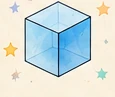
A square is two-dimensional. A cube is three-dimensional. We can also study four-dimensional geometry mathematically.
2. Shapes Can Change
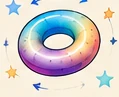
We can translate, rotate, and sometimes bend shapes. These operations are not all the same.
3. Everything Is Connected
Geometry explores connections, loops, surfaces, and what stays the same when forms change.
4. We Can Visualize It
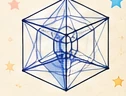
Drawings and projections help us reason about structures we cannot directly see.
Fun Examples
A Square and a Cube
A square has length and width. A cube also has depth. A cube is not literally created just by moving a square on paper.
A Circle and a Torus
A torus is a donut-shaped surface. One way to construct it mathematically is to rotate a circle around an axis outside the circle.
A Cube and a Tesseract
A tesseract is a four-dimensional analogue of a cube. We can draw a two-dimensional projection of it.
Move It. Turn It.
Draw a square with four sides and four corners. Slide it across the page: that is a translation. Turn it: that is a rotation. Its size and shape remain unchanged.
Find the Hidden Slice
Imagine a perfectly flat plane cutting a sphere. Depending on where the plane passes, the cross-section can be a large circle, a small circle, a point, or no intersection at all.
Why Does It Matter?
- Recognizing patterns in nature and design
- Working with diagrams, maps, and models
- Understanding scientific visualization
- Practicing spatial reasoning and creative problem-solving
✎ Try It Yourself!
- Draw a square and mark its four corners.
- Draw the same square rotated.
- Sketch a ball and a plane through its middle.
- Ask what is visible and what remains hidden.
Quick Recap
Geometry helps us ask better questions about shapes and space. A drawing is a powerful thinking tool, but a drawing alone cannot prove how the universe works.
Explore the Scientific Version →